WhatsApp
 Eric.wang@ltzzc.com
 0086-379-69950051

What is an excavator slew ring?
What is an excavator slewing ring?
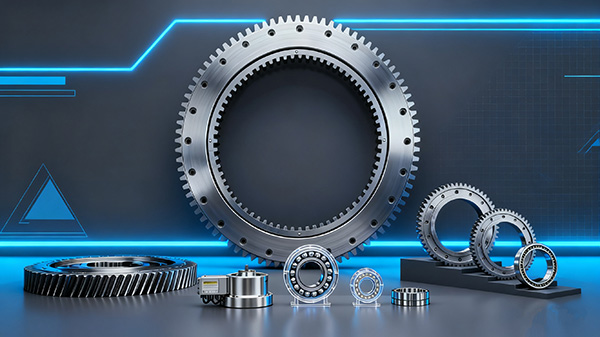
A slewing bearing, also known as a turntable bearing, is primarily responsible for the rotation of machinery. It connects the upper structure and lower chassis of the machinery, supporting the weight of the upper structure and bearing the axial force, radial force, and overturning moment generated during operation. At the same time, it allows the upper structure to rotate flexibly relative to the lower chassis. Therefore, the slewing bearing is a critical component for the rotation of machinery.
Slewing bearings typically consist of an inner ring, an outer ring, rolling elements, and sealing devices. The inner ring is generally fixed to the upper structure of the excavator, the outer ring is connected to the lower chassis by bolts, and the rolling elements are placed in the raceway between the inner and outer rings to allow for relative rotation. The sealing device prevents dust, dirt, and moisture from entering the bearing, ensuring its normal operation. There are many types of slewing bearings, the most common being: single-row roller slewing bearings, double-row roller slewing bearings, crossed roller slewing bearings, and three-row cylindrical roller slewing bearings, which differ in design structure, load capacity, and other aspects,these attachments are designed to fit excavators of different tonnages, and are manufactured from high-quality alloy steel through rigorous heat treatment and processing, ensuring strength, wear resistance, and reliable performance.
What are types of excavator slewing bearings?
Excavator slewing bearings (slewing rings) are adapted to excavators of different tonnages and operating conditions based on their structure and load-bearing characteristics. The mainstream types are divided into three core categories: single-row ball type, double-row ball type, and crossed roller type. There is also a three-row roller type for ultra-large excavators. Each category differs significantly in structure, load capacity, and applicable scenarios, with the following specific characteristics:
Single-row ball slewing bearing: The simplest structure, with a single set of steel balls as rolling elements in the raceway. It has a small overall volume, light weight, and low manufacturing cost. It can withstand certain axial force, radial force, and overturning moment, and is suitable for small and medium-sized excavators, meeting the needs of conventional earthmoving and light-duty excavation operations.
Double-row ball slewing bearing: Designed with two sets of steel balls as rolling elements in the raceway, providing a larger load-bearing contact area. It can withstand axial forces and overturning moments far greater than the single-row ball type, and also has improved radial load capacity. It offers greater structural stability and is the mainstream choice for medium and large excavators, suitable for heavy-duty excavation, mining operations, and other complex working conditions.
Crossed roller slewing bearing: The rolling elements are rollers arranged in a crisscross pattern. The rollers and raceway have line contact, resulting in extremely high rigidity and good rotational accuracy. It can withstand large loads within a limited installation space and has excellent resistance to eccentric loads. It is suitable for excavator models with compact space and high requirements for rotational accuracy and load-bearing rigidity, and is also commonly used in some medium-sized precision excavators.
Three-row roller slewing bearing: Features three rows of rollers to withstand axial force, radial force, and overturning moment separately. It has the strongest load capacity among all categories and can handle extremely heavy loads and strong impact working conditions. It is only suitable for ultra-large mining excavators and other heavy-duty equipment. It has high manufacturing costs and a large volume.
How to Select Excavator Slewing Bearings?
The key to selecting excavator slewing bearings is matching the equipment tonnage and operating conditions, while also considering critical indicators such as installation dimensions, load characteristics, and transmission requirements. The selection process should follow the logic of determining core parameters first → matching operating conditions → verifying installation and compatibility → controlling quality standards, to avoid premature wear and breakage of the bearing due to improper selection,which would affect the equipment's operating efficiency.
| Excavator Tonnage | Core Structural Type | Gear Ring Type | Precision Grade | Mounting Type | Applicable Working Conditions |
|---|---|---|---|---|---|
| 3–6 ton | Precision type Single-row crossed roller bearing | External straight gear | Grade P6 | Flangeless | Precision operation / Compact installation space |
| 6–20 ton | Small & medium type Four-point contact single-row ball bearing | External straight gear | Grade P0 | Flangeless | Routine earthwork / Municipal engineering |
| 20–80 ton | Medium & large type Eight-point contact double-row ball bearing | External straight gear | Grade P6 | Flanged / Flangeless | Mining / Heavy-duty excavation |
| Over 80 ton | Extra-large type Three-row roller bearing (Helical gear optional) | External straight gear / External helical gear | Grade P6 / P5 | Flanged | Extra-large mining operations |
LTZC Excavator Slewing Bearing Solutions
Leveraging over 20 years of experience in large bearing research and manufacturing, LTZC focuses on bearing manufacturing for heavy machinery such as excavators, cranes, mining equipment, and marine equipment, providing a one-stop solution encompassing "selection-customization-supply-installation-after-sales service," balancing reliability, cost-effectiveness, and compatibility, and offering alternatives to imported products.
1. Customized Solutions
We provide exclusive customized services for non-standard models, special working conditions, and import substitution needs. Sizes: outer diameter Φ300mm-Φ12000mm. We utilize manufacturing processes such as double-seal design and deep hardening for harsh working conditions.
2. Quality and Supply Guarantee Solutions
We use high-quality 42CrMo alloy steel, with precision covering P0-P4 grades, complying with domestic and international standards such as GB/T 30431 and ISO 6128-1. We are ISO9001 certified, and each bearing undergoes full-process inspection including dynamic balancing and precision testing.
3. Full-Cycle After-Sales Solutions
We provide guidance on bearing installation and lubrication maintenance; we respond to technical questions within 24 hours and fulfill contracts with guaranteed quality and quantity, ensuring stable operation of bearings under corresponding working conditions, and providing long-term technical support.
contact LTZC for bearing solutions